Bzzz!
Perspective
I am writing a non fiction book for children about, wait for it...tea. Sound a bit insipid? After a few hours this morning I took a little break and my mind wandered back to the stark reality of the present. April 15, 2020.
Question to self: "Is what your doing helping?" I let it sink in for a while. Chewed on it, swallowed, and saw a child reading about camel caravans on the Silk Road and about the Boston Tea Party. Perhaps for the first time encountering the terms "colonization" or "fair trade". History can sometimes be a hard thing for kids to understand. It seems like fiction but it isn't. It doesn't feel real but it evokes real empathy. The history of something as everyday humdrum as tea may appear not to address anything important. Or does it?
As a Montessorian I am steeped in the philosophy that my task is not to fix things, but rather to create an environment ripe for understanding. Real understanding - of history, and perhaps even an awareness that it is history we are living right now. Time can be relative - especially when one is immersed in a book or learning something new. Even if it's something about a boring old cup of tea. Learning about history kids can see their place on the continuum and ultimately make decisions with an expanded perspective. That, my chamomile friends, is knowledge.
Question to self: "Is what your doing helping?" I let it sink in for a while. Chewed on it, swallowed, and saw a child reading about camel caravans on the Silk Road and about the Boston Tea Party. Perhaps for the first time encountering the terms "colonization" or "fair trade". History can sometimes be a hard thing for kids to understand. It seems like fiction but it isn't. It doesn't feel real but it evokes real empathy. The history of something as everyday humdrum as tea may appear not to address anything important. Or does it?
As a Montessorian I am steeped in the philosophy that my task is not to fix things, but rather to create an environment ripe for understanding. Real understanding - of history, and perhaps even an awareness that it is history we are living right now. Time can be relative - especially when one is immersed in a book or learning something new. Even if it's something about a boring old cup of tea. Learning about history kids can see their place on the continuum and ultimately make decisions with an expanded perspective. That, my chamomile friends, is knowledge.
A Decade of Learning
We hold things in our hands for just so long. They slip away or are replaced by new things to touch and explore. The dream of a beautiful school for young children began much earlier than ten years ago. We have just been holding it close for that long here in this place. What a golden time we have had with memories that we will never let go. May it be so for many years to come and offer something lovely for children to hold onto forever.
Thank you!
Summer!
Summer is a great time for children to explore the world around them, experience the joy of self-discovery and enjoy a variety of age-appropriate activities geared for their individual needs and interests. As a Montessori Children's House camper, your child will get all of this and more.
Our child-centered Montessori summer camp is playful, relaxed, and fun. It is an ideal change of pace for the summer months for our 2.5 – 8+ year old campers. We combine the best of Montessori – love of learning, free choice, independence, mutual respect, and hands on learning– with the charms only summer can afford – plenty of sprinkler and water fun, outdoor games, nature walks, gardening, fantasy play, arts and crafts, cooking, sewing, science experiments, and picnic lunches. Your child will make friendships through play, improve motor, language, and socialization skills, and continue their personal path of growth.
Our MCH summer camp is open to everyone – all families, friends, and neighbors of Montessori Children's House. If you desire a great way to transition your child entering our program in the fall, a first time camp experience, a camp staffed with our experienced and nurturing teachers, consistency and convenience for your family, or the option to choose individual weeks as needed, look no further than MCH. We can’t wait for your child to enjoy this fun-filled time of year with us!
Qualities We Look For
Parent/Teacher Conferences are coming up, and we are deep in the effort of communicating what exactly goes on at MCH for your child. It is a good time to revisit this article from Montessori For Everyone to remind us all of the sterling qualities of a Montessori child.
How we Celebrate
Once the sugary
Halloween kickoff to the holiday season is over we snuggle into the pace we
have developed at our school to comfortably enjoy the time between October 31
and December 31. Much of the comfort lies in our observation of Montessori
principles in all we do with the children. We keep to our familiar routines as
families feel theirs perhaps scattering or speeding up. Our cooking classes take
place on Thursdays so we can reap the rewards at the snack table the next day or take them home to share with family. Rolling and grinding, stirring
and measuring skills are practiced but an additional benefit of cooking
together is to give the children an opportunity to develop a love of preparing
food with friends. Each week there are numerous requests before Thursday
arrives of, "Is it cooking day today?"
We make herb bread and cranberry-orange relish just in time for a contribution to the Thanksgiving table.
In December we explore traditional European dishes, like potato latkes and Santa Lucia buns.
We make herb bread and cranberry-orange relish just in time for a contribution to the Thanksgiving table.
In December we explore traditional European dishes, like potato latkes and Santa Lucia buns.
As is the custom at our school gift giving often involves a cooking project and our last one of the year is a festive holiday sleigh made of graham crackers and decorated with lots and lots of love.
Cooking in the Children's House--#2 Orchard Applesauce

Apple Harvest
O down in the orchard
'Tis harvest time,And up the tall ladders the fruit pickers climb.
Among the green branches
That sway overhead
The apples are hanging
All rosy and red.
Just ripe for the picking,
All juicy and sweet.
So pretty to look at
And lovely to eat.--Helen Leuty
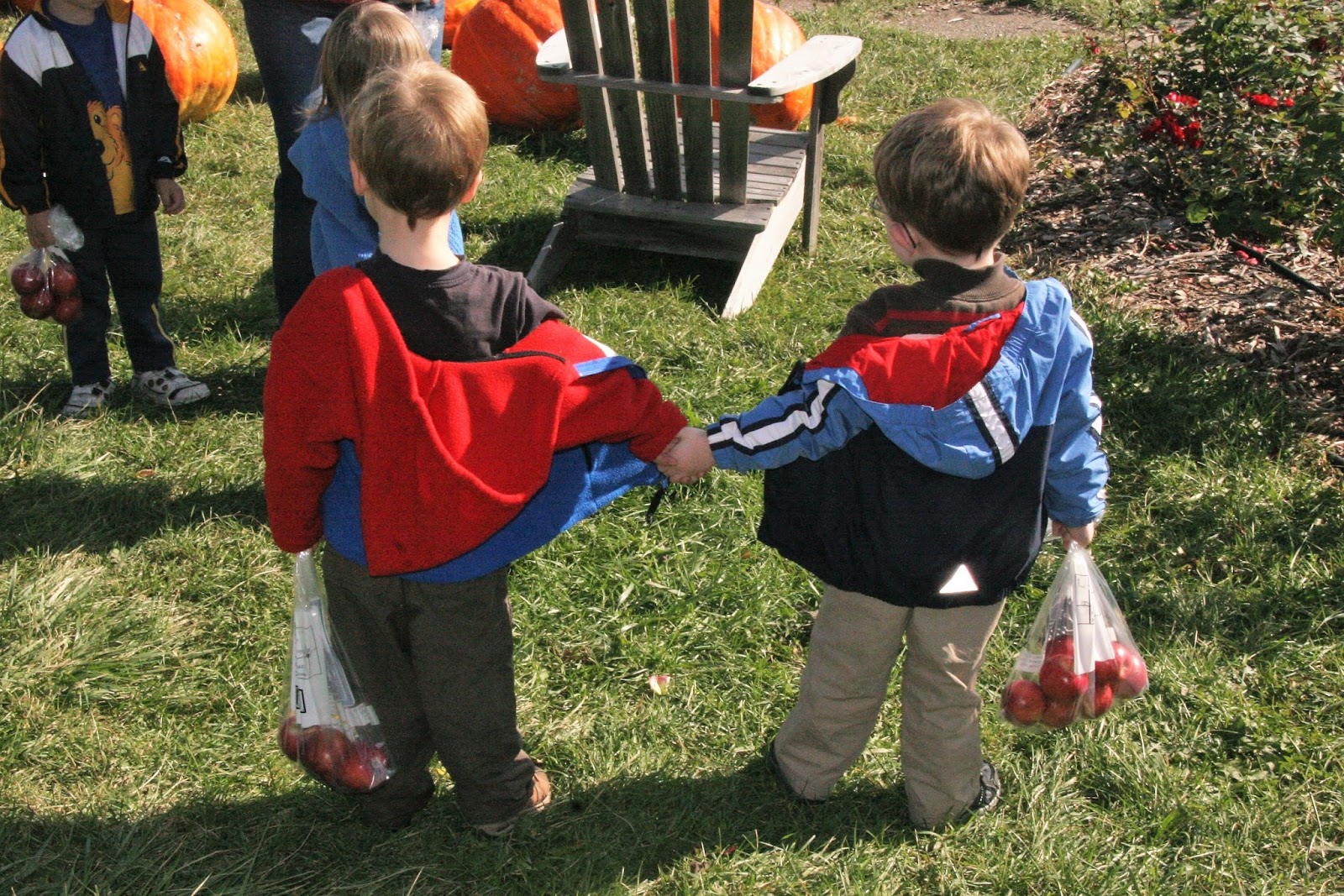
One of the great pleasures of fall here in the Midwest is a trip to the apple orchard. It is our tradition to take the first field trip of the school year to a local orchard and then come back and make delicious from scratch applesauce. This process--literally orchard to snack table--gives the children a real sense of how one of their favorite foods is created.
First stop is a tour of the apple orchard
with a peek at the pie and cider making
this orchard has a donut machine...


Back at school we get to the applesauce making--
Applesauce
8 apples
¼ t salt
½ cup water
¼ t nutmeg
½ cup sugar
½ t cinnamon
Quarter apples, remove cores and add to water. Stir in sugar, salt, and spices and simmer for one hour. Adjust sugar for sweetness of apple.
Apple Star
It is very beautiful to
take an apple and cut it across the middle because throughout the center you
find the shape of a star. You cut apples into very thin slices this way and
give them to the children and they eat around the center star.
Apple Facts
What you don’t know about
apples will seldom hurt you a bit. Sure, there are experts who know and use
certain varieties for certain dishes, and you will too. But all apples are good
to eat out of hand depending on your taste for sweet or tart, soft or firm. And
there are many varieties good for all purposes. A few of these are:
McIntosh Jonathan
Ida Cortland
For pies and baking:
Northern Spy Wine sap
Wealthy Rome Beauty
Baldwin Spartan
For lunchboxes and
salads:
Red & Golden
Delicious Honey crisp
3 medium apples=1 pound
3 medium apples (peeled
& sliced)=2 ¾ cups
1 average apple=80
calories
School Connections
Freedom
A central tenet of Montessori’s pedagogy and philosophy holds that children must be free to follow their natural interests, leading to opportunities to develop their potential and increasing their knowledge of the world. Within the prepared environment, the child must experience freedom in a number of ways, including: movement, exploration, ability to interact socially, and the freedom to learn and grow without interference from others.
Structure and Order
On the surface, structure and order may seem at odds with the importance of freedom in the prepared environment. The prepared environment is meant to reflect the considerable structure and order of the real world and presents an organized system that children must learn to understand in order to make sense of their surroundings and, ultimately, the world. The ordered environment supports children’s ability to reason and provides consistent opportunities for children to validate their expectations and interactions with the world around them in predictable and consistent ways.
Social Environment
The multi-age classroom groupings provide tremendous benefit to children as part of the prepared environment. Any number of benefits accrues to children as a result of learning within the Montessori social environment. The opportunity to be the youngest, middle and oldest student cohort over time affords children unique perspectives and experiences at each stage. At different times they receive help from older children or aspire to do things that older children do, they serve as role models or mentors for younger children and they have regular opportunities to develop compassion and empathy for others. In addition, children’s ability to work and play in a variety of group settings is explicitly supported by the social environment that is intentionally created as part of Montessori’s methodology.
Intellectual Environment
The prepared environment ultimately aims to develop the whole child, not just the intellect, but intellectual development will not occur without the previous aspects of the environment in place. The above aspects of the prepared environment, coupled with the Montessori curriculum and unique Montessori materials, supports children in moving from simple to complex ideas and from concrete to abstract understanding and manages to do so in a way that is truly individualized and differentiated.
Experiences in Nature
The opportunities we give them to interact and develop a relationship with the natural world, will help them to develop tools for environmental responsibility and ecological understanding. With young children sometimes spending up to 50 hours per week in early childhood settings, early childhood educators have an important role. Opportunities for our young children to explore the wonders of plants, bushes, trees, flowers, and animals are diminishing. We have to give them time and places to explore and interact with nature before they can understand it well enough to want to look after it.
It is a lot to explain on a short school tour... and the purpose of this post is certainly not to overwhelm parents during the decision making process. Our goal is to impart a bit of this way of looking at the world of the child. They truly know their own child and can envision an environment in which he or she would thrive. We hope that in their time with us they feel just that, and experience a real sense of connection.
Subscribe to:
Posts (Atom)
-
Today was no ordinary day. Starting at the meeting rock, we trudged uphill to find a dry spot. We shared and we listened. My stump...