Garden Party

Every garden begins with a seed. Ours was planted years before the land was even purchased on the outskirts of Northfield, MN. Edible Schoolyard creator, groundbreaking chef and former Montessori teacher, Alice Waters, was a huge influence and inspiration as I dreamed about my ideal school environment. The school garden, from which we would gather vegetables and herbs for cooking and sharing with families, was the very first thing that took real form at our school site.
The months before our opening in the fall of 2007 were filled with renovation and construction. Lots of trucks, lots of debris, and what felt like very slow progress. It was quite an overwhelming and anxious time. The clearing and plotting out of the school garden was, in contrast, a much more manageable task. The demolition of a small barn behind the house had left a plot of very fertile soil (the barn had housed some calves over the years, I believe). Although we raked and raked the soil that summer, each spring we still find remnants of that structure, mostly window glass and splinters of red painted wood.
Many friends  came out to lend a hand, one was a master gardener who tested our soil and dispensed invaluable advice to this non-farming teacher.
The garden began to take shape. We were so eager to plant so that everything could grow over the summer and greet the children when they arrived in the fall. We chose vegetables, herbs and fruits that would be complements to the cooking program I had always enjoyed in my classrooms.

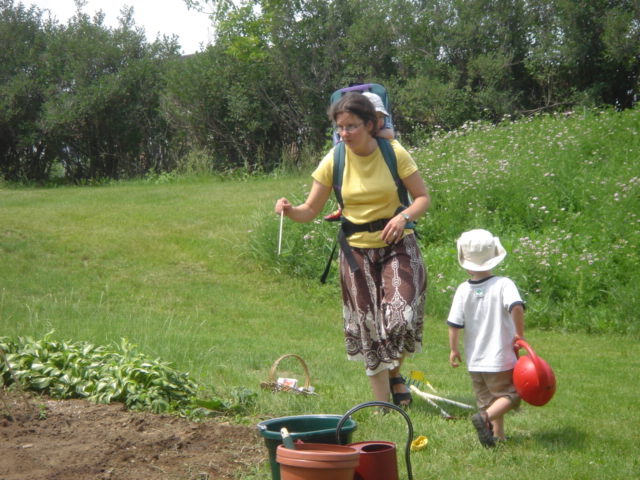
Enrollment was in full swing for this new school and we were ready to host an informal "Garden Party" for families to join us out at our property. The building was still very much a construction zone but everyone was eager to come help plant and finish off the edible schoolyard for their children.
Planting the garden was so satisfying and symbolic for all of us. It wasn't September yet, but already our school felt like a community--filled with love, joy and the promise of new growth.
Next: The garden goes live.


It's Summer--What's Cooking?

Summer cooking at Montessori Children's House means an outdoor kitchen. Our entire program moves outside for the months of June, July and August. The children arrive each morning and enter an environment designed to extend the Montessori method into a natural outdoor space. What a joy to be able to provide this environment, but it is not without an element of preparation. During these warm lazy days of summer I would like to outline the preparation of a Montessori summer kitchen, beginning with the details of how we built our outdoor environment.
Next post: "Garden Party" - a dream, a plot of land, a community working together for children


Cooking in the Children's House--Peanut Butter


Spring Recipes
-Peanuts


Peanut Butter     
Ingredients:

·         roasted peanuts in the shell

·         vegetable oil                 

·         honey or sugar

Tools:


Ingredients:


Let’s go:
Peanut butter is a fun and easy recipe to make!

Crack open the shells and remove the peanuts.


We place peanuts in plastic bags and use a clean stone from our garden to crush them.


If you want chunky peanut butter, put the peanuts in a food processor or grinder and run the chopped mixture through three or more times until the peanut butter is the consistency that you like.


For creamy style peanut butter, chop up the peanuts in a blender. Add about one to two tablespoons of oil in small amounts and regrind or blend the mixture until the peanut butter is the desired consistency. Add sugar or honey by the teaspoon until the taste is just right.


Store in refrigerator. Homemade peanut butter contains no preservatives or other

additives and has a wonderful fresh peanutty taste.


Summertime at MCH


A playful, meaningful connection with the world outdoors needs to be a fundamental ingredient of every childhood. An integral part of the Montessori philosophy is the belief that children learn through personal experience. The summer at Montessori Children’s House focuses on increasing the child’s awareness, particularly in the area of life sciences. The summer is an ideal time for exploration of the natural areas, bird life and other animal life surrounding our school. Many practical life activities like washing, scrubbing and polishing are moved outdoors. The program is designed to involve children in environmental education through interactive stories, songs and games.  They create arts and crafts projects and conduct experiments and scientific studies.  Regular cooking classes take place in our summer kitchen and feature healthy products picked on site. Outdoor exploration includes nature walks and scavenger hunts as well as tending our MCH school garden and creating a mini-farmer’s market and lemonade stand.

A special session in late summer focuses on increasing the child’s awareness in the area of music learning. Parents recognize the earliest signs of musical interest when children begin to capture portions of songs and move in response to music. To reinforce a child’s spontaneous musical activities leads to enhanced natural development of communication, expression, and cognition. It is also a lot of fun! Along with the American Orff-Schulwerk Association we at MCH are united in our belief that music and movement—to speak, sing and play; to listen and understand; to move and create—should be an active and joyful experience.

Summer programs at MCH are open to current, past and future families who seek a nature based play environment where their children can explore and learn in a community of friends.

Cooking in the Children's House--Honeybees

Spring Recipes
Honeybees
2 cups peanut butter
4 T honey
1 1/4 cups non-fat dry milk
8 T sesame seeds
8T wheat germ
Mix together ingredients.
Form dough into ellipsoids. We bring the geometric solid ellipsoid to the cooking table to feel before starting.
Apply cocoa powder with a toothpick to form stripes and sliced almonds for wings.


Recipe makes 60 bees ready to buzz home in snack sized plastic bags.


Creating the Montessori Environment

This is a post I have been meaning to write for a long time. As a second generation Montessorian and thirty year practitioner, I feel very strongly about the authenticity of a Montessori learning environment. Creating such environments for children has been my passion since the beginning of my career and an aspect of the practice that never gets old for me. This is the first of a series I plan to post here at The Children's House to inform and inspire those searching for ideas and methods for creating a space for children to explore and experience the joy of learning. It's a big task, I know, and my hope is to illicit help and wisdom from all the other Montessorians out there who have dedicated their time and energy to creating these environments in schools and at home. Please join in the conversation with me and share what you are passionate about--photos encouraged.

Cooking in the Children's House--Jiao Zi

Here's what's cooking this week--
Ingredients                     50 dumplings                               


Directions                    

  1. To make the filling mix the pork with the soy sauce and 1/2 teaspoon of the salt. Stir carefully, always in the same direction, to create a thick paste. Add the rice wine and oil. Mix in the same direction. Cover. Let rest 20 minutes.
  2. To prepare the cabbage, sprinkle with the remaining salt to help draw out the water. Add the ginger, scallion, and pepper and knead for at least 5 minutes into a thick paste. Combine with the filling.
  3. To make the dumplings, put about 1 tablespoon of the filling in the center of each skin, holding the skin in the palm of one hand. Moisten the edges with water, then seal the edges with 2-3 pleats on each side and transfer to a lightly floured board.
  4. To cook the dumplings, bring 4 cups water to a boil in a large pan. Drop in about 20 dumplings at a time, stirring gently with a chopstick to prevent them sticking together. Cover, the return to a boil and cook for 2 minutes. Uncover and add a generous cup cold water. Return to a boil, then cover and cook for an additional 2 minutes. Remove with a slotted spoon and keep hot while you cook the remaining jiaozi. Serve with dipping sauce.

Happy Chinese New Year of the Rooster!

We always feel so connected to the larger world when we celebrate the Lunar New Year at MCH. It has become a highly anticipated tradition for us and a bit of a rite of passage for the oldest students who lead the parade. At this year's celebration we listened to our teacher, Shana, play the erhu, sang Chinese songs and had a short presentation by the extended day students about the legend of the Chinese zodiac animals. We feel strongly about giving children a global experience through our unique world languages instruction. Participating in this holiday celebration gives our students yet another way to feel connected to places far a way from our little Minnesota town.
Happy Year of the Red Rooster!


Yes, our own MCH roosters got a special treat, too!

The Third Year--Montessori Kindergarten

It's that time of year at MCH when parents of our second year students begin the decision making process for re-enrollment. We applaud and support them in this important process. It can seem like an overwhelming responsibility to choose the best class for your child. We hold a special meeting just for them at our school or online to offer guidance and explain which choice we feel is the best for our Montessori students. While not everyone can stay for the third year at our school, our hope is that those who can will do just that. It is a gift that will pay huge dividends in the child's outlook on learning. We feel so strongly about it that all of our scholarship money in the past has gone to making the third year choice an easy one for parents. As an authentic Montessori school, we are committed to the three year cycle in the classroom and to offering the best possible Montessori primary education to each child. We serve the Watcher (3 year old), the Worker (4 year old) and the Teacher (5 year old). It is both our mission and our pure delight.
Here are some of the videos we'll share at our information meetings:


Cooking in the Children's House--Bird's Nests

Video What's Cooking?


Bird’s Nests with Candy Eggs


Nests

Mix 1 cup All Bran cereal with one egg white. Press into a small bowl or cup.


Candy Eggs
2 small pkgs cream cheese
1 lb powdered sugar
food coloring (robin’s egg blue), candy flavoring extract (vanilla)
Knead together cream cheese and sugar. Work in food color and flavoring. Take small amount and roll in granulated sugar. Form into a small ovoids and place into nest to dry.